How to Write SEO Content That Actually Ranks (7 Easy Tips to Follow)
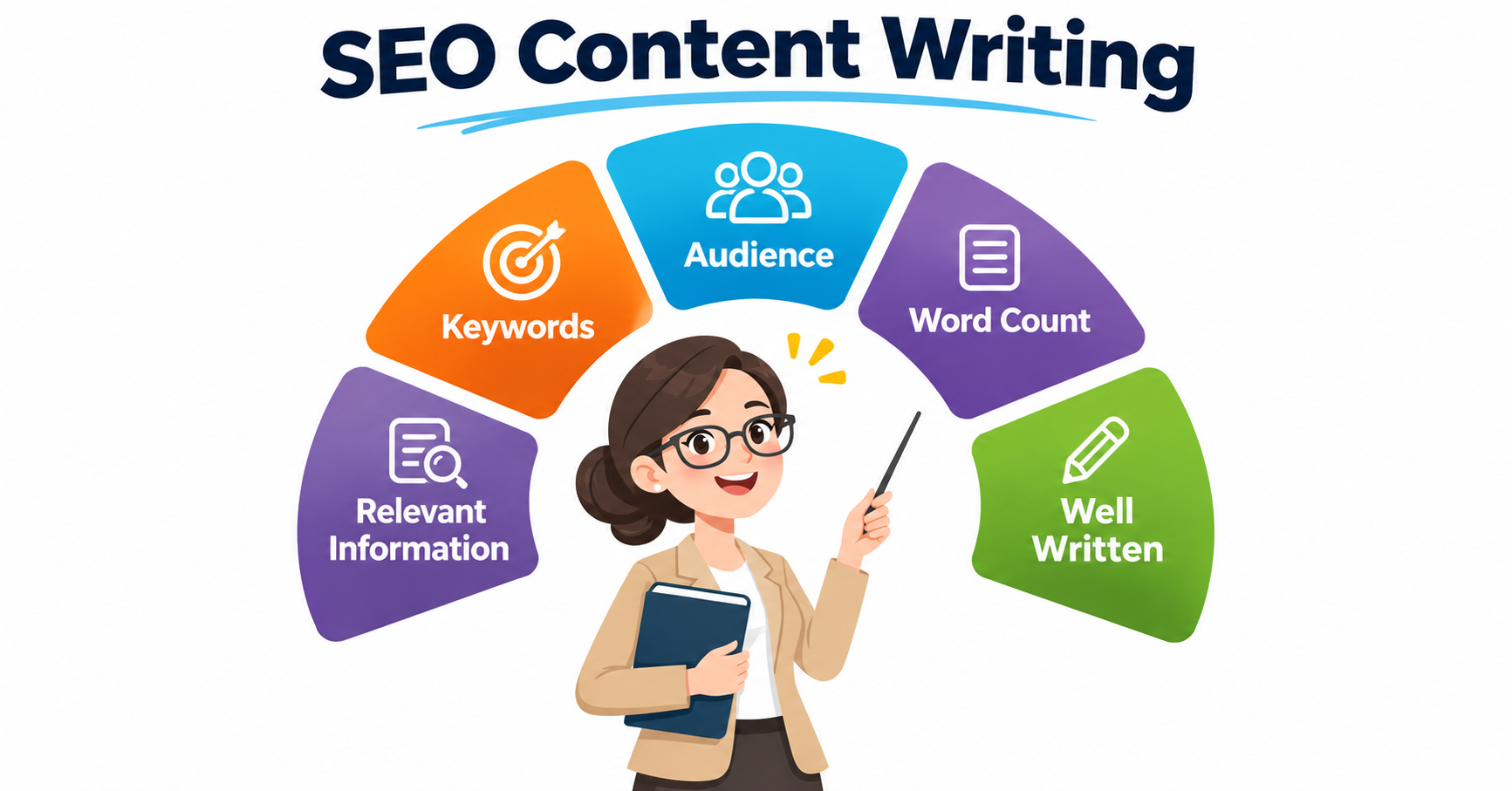
You spent hours on that post. You hit publish, refreshed your traffic, and waited. And waited. Days later? Crickets.
Here’s the thing. Your content might actually be good. It just was not built to be found, so Google quietly skips right past it while weaker posts outrank you.
I’ve seen this happen to so many brands, and it stings every time. But it is not a writing problem. It is a process problem, and the good news is it is completely fixable. Below is the exact process I use to write content that ranks on Google and gets pulled into AI answers.
What Is SEO Content Writing?
SEO content writing is just creating content that search engines can find, readers actually want, and AI tools can understand. In plain English, it is helpful content plus smart optimization.
The real difference from regular content is where you start. Regular content starts with what you want to say. SEO content starts with what people are already searching for.
Skip that starting point and you are basically writing a diary entry and hoping Google notices. Trust me, it rarely does.
1. Start With Keyword Research
Keyword research is simply deciding what you want to show up for before you write a single word. You are matching real demand with content you can actually create.
A few tools make this easy. Ubersuggest, Ahrefs, and Semrush all show you search volume, difficulty, and related terms, while Google Search Console shows what you already rank for. Even Google’s own autocomplete and “People Also Ask” boxes are goldmines if you are on a budget.
Let me show you what this looks like in real life. When I researched this exact topic, “how to write seo content” pulled around 210 searches a month with informational intent, meaning people want to learn, not buy.
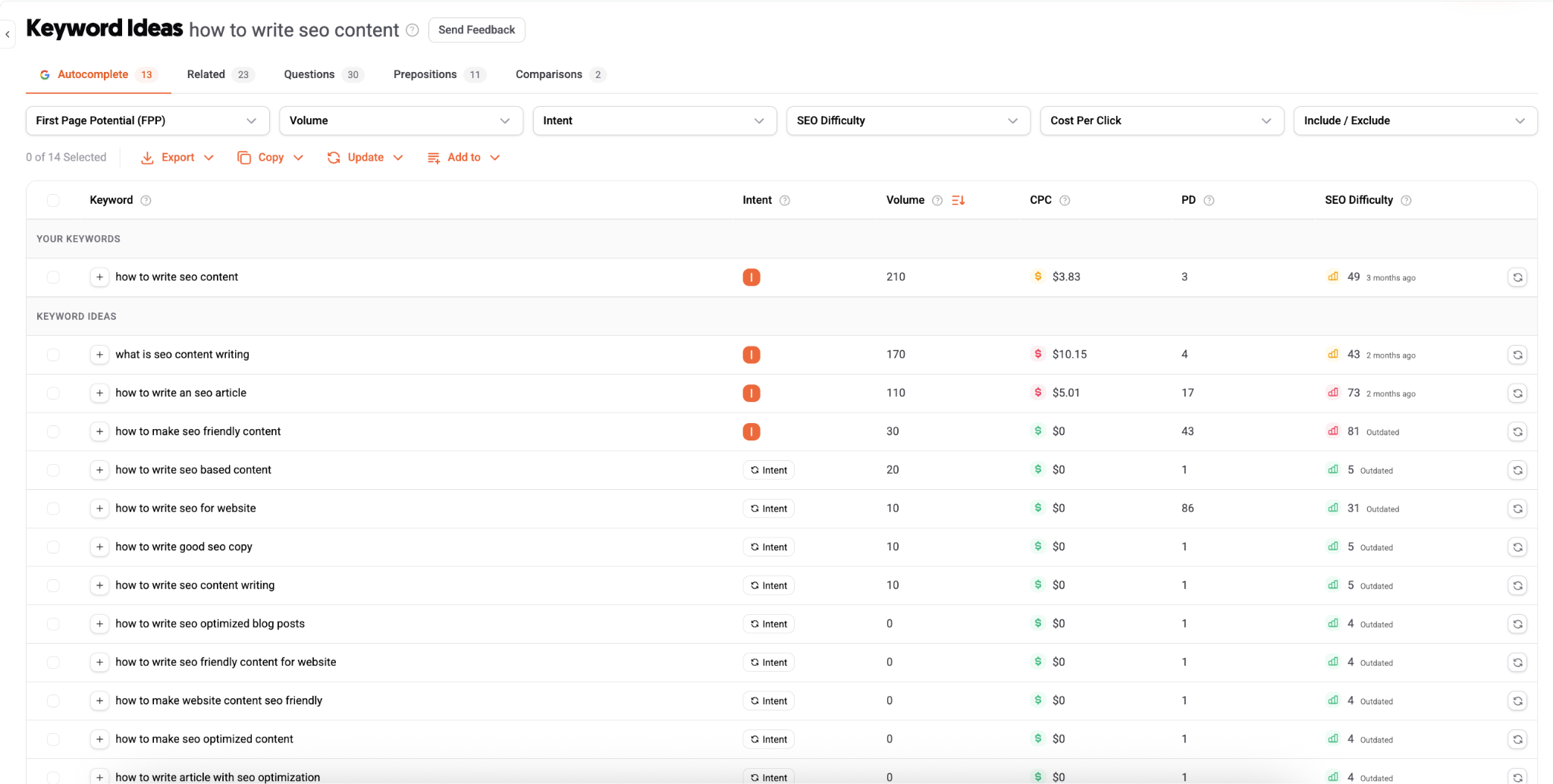
But here is the part most people skip. The real gold is sitting in the related searches right next to it.
Look at what people actually type: “what is seo content writing,” “how to write an seo article,” and “seo content writing examples.” That list basically handed me the subtopics for this whole post.
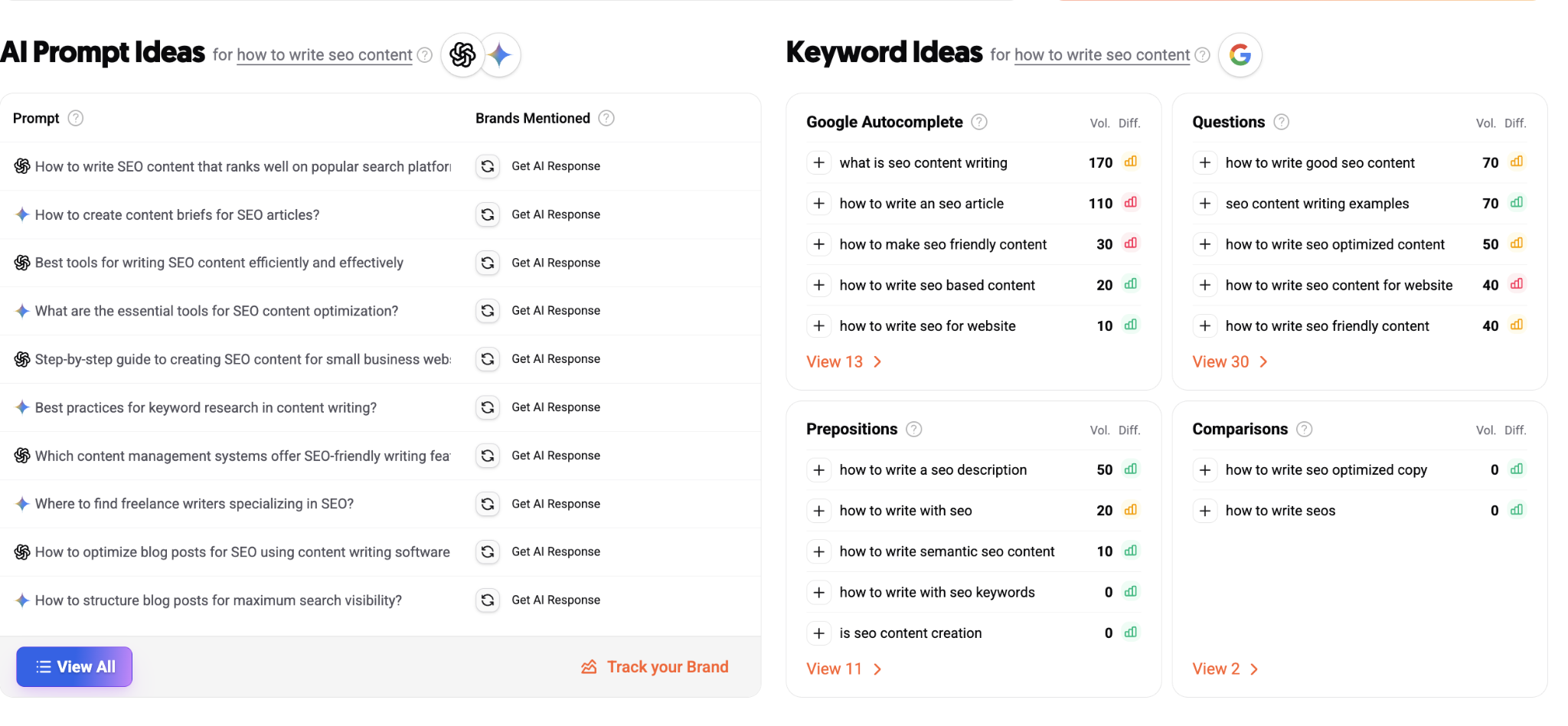
So each page should target one primary keyword, then naturally cover those related terms and questions. You are not guessing what to write. The data is quietly telling you.
If your site is newer, start with the longer, lower-difficulty phrases first, since they are far easier to win. Grouping these keywords into topic clusters, which is the heart of good content strategy, helps your whole site build authority instead of a few scattered posts.
2. Match Search Intent Before You Write
Search intent is the “why” behind a search. Get this wrong and even beautiful writing will not rank.
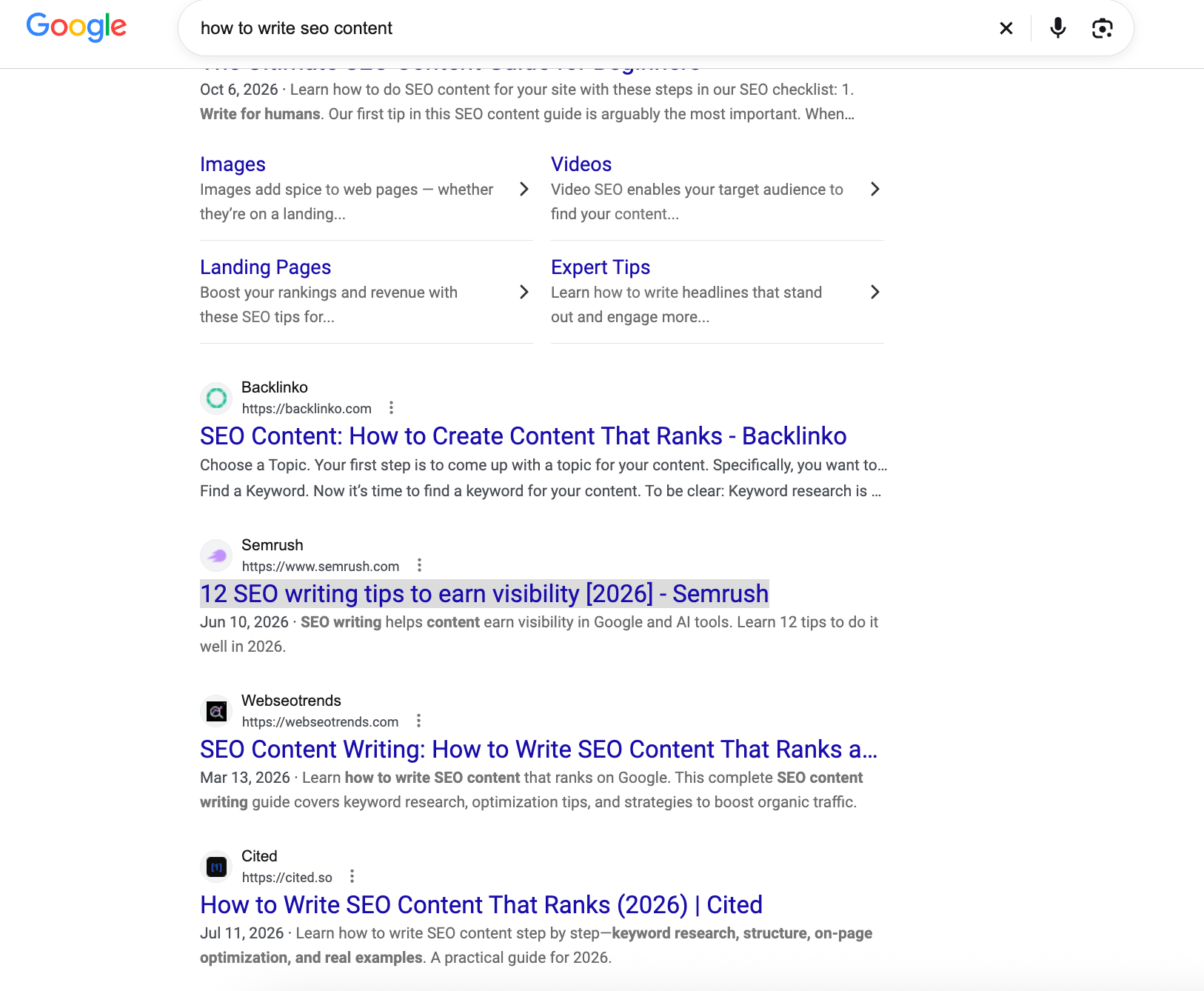
The fastest way to figure it out? Google your keyword and study what is already on page one. If it is full of how-to guides, people want a guide, not your sales pitch.
So before you write, ask yourself:
- What format keeps showing up (guide, list, comparison, product page)?
- What questions do the top results keep answering?
- What is missing that you could do better?
Give searchers the format they expect, then make yours genuinely more useful.
3. Write Helpful Content That Earns Trust
Okay, this is where most content quietly dies. People rewrite what is already ranking and then wonder why they are stuck on page three.
Google wants original, genuinely helpful stuff. So do not just summarize. Add your own take, real examples, and little details that prove you actually know what you are talking about.
Show real experience and expertise (E-E-A-T)
E-E-A-T stands for Experience, Expertise, Authoritativeness, and Trustworthiness. It is basically how Google decides if your content deserves to rank, and trust is the one that carries the most weight.
You build it by sharing firsthand experience, pointing to credible sources, and being clear about who actually wrote the piece. Honestly, I watch brands skip this all the time, and it is usually why their “perfectly fine” content just sits there doing nothing.
So add a real byline. Share what you have actually seen or tested. Say something only someone who does this work would know.
Note: Google’s own advice is to create helpful, people-first content, not content built just to game rankings. It now leans hard on effort, originality, and real authorship, and even warns against faking authors. So write for a human first, then optimize.
4. Structure and Format for Easy Reading
Good structure helps people scan and helps search engines make sense of your page. Both matter, equally.
Use one H1 for your title, H2s for main sections, and H3s for the smaller points inside them. Build an outline before you write so your flow actually makes sense.
Then make it easy on the eyes:
- Keep paragraphs short, around two to three sentences.
- Use simple words and short sentences.
- Break things up with bullets, subheadings, and visuals.
Let’s be honest, nobody reads a giant wall of text. We all scan. And if your readers cannot scan yours, they are gone.
5. Optimize Your On-Page SEO Elements
SEO is everything you control on the page itself. These are the basics every piece needs before you hit publish.
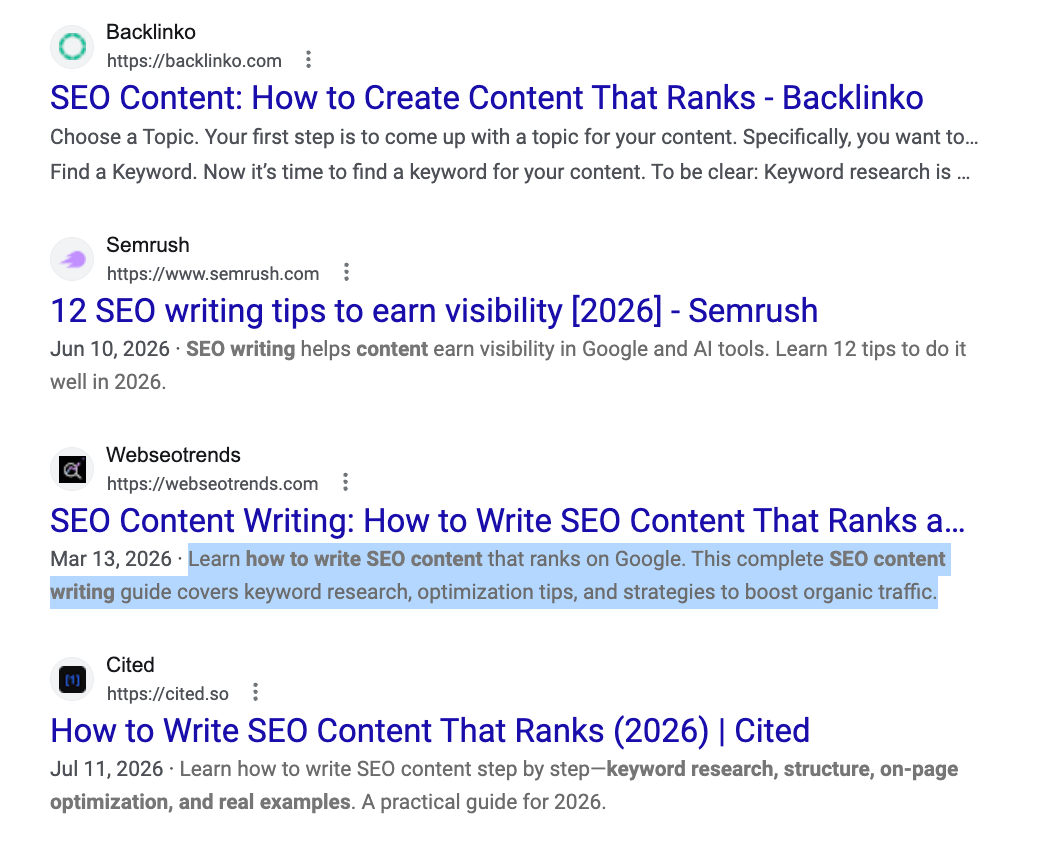
Title tags, meta descriptions, and URLs
- Title tag: around 55 to 60 characters, with your keyword near the front.
- Meta description: one or two short sentences, under about 155 characters, with a real reason to click.
- URL slug: short, lowercase, keyword first, words split with hyphens.
Also work your keyword into the first 100 words, a subheading or two, and your image alt text. Keep it natural, though. If it reads like a robot crammed keywords in, people bounce and your rankings follow them out the door.
6. How Long Should SEO Content Be?
Here is the honest answer nobody wants to hear: there is no magic word count. A simple “what is” post might need 800 words, while a full guide might need 2,500.
Google has actually said this straight up. It has no preferred word count, so writing to hit some number does nothing for you.
Instead, match your length to the topic and to what is already ranking. Cover it completely, then stop, because padding fools no one.
Worth knowing: One analysis of 11.8 million search results found the average first-page result had about 1,447 words, and that word count was spread evenly across the top 10. So length alone is not the win. Covering the topic thoroughly is what actually moves you up.
7. Writing SEO Content for AI Search
Search is not just blue links anymore. People now get answers straight from AI Overviews, ChatGPT, and similar tools, often without clicking anything at all.
That changes how you write. You want content that is easy for AI to read and trust, but also content AI cannot simply copy.
Here is a real example. An article I wrote now gets pulled into Google’s AI Overview and cited right there in the answer.
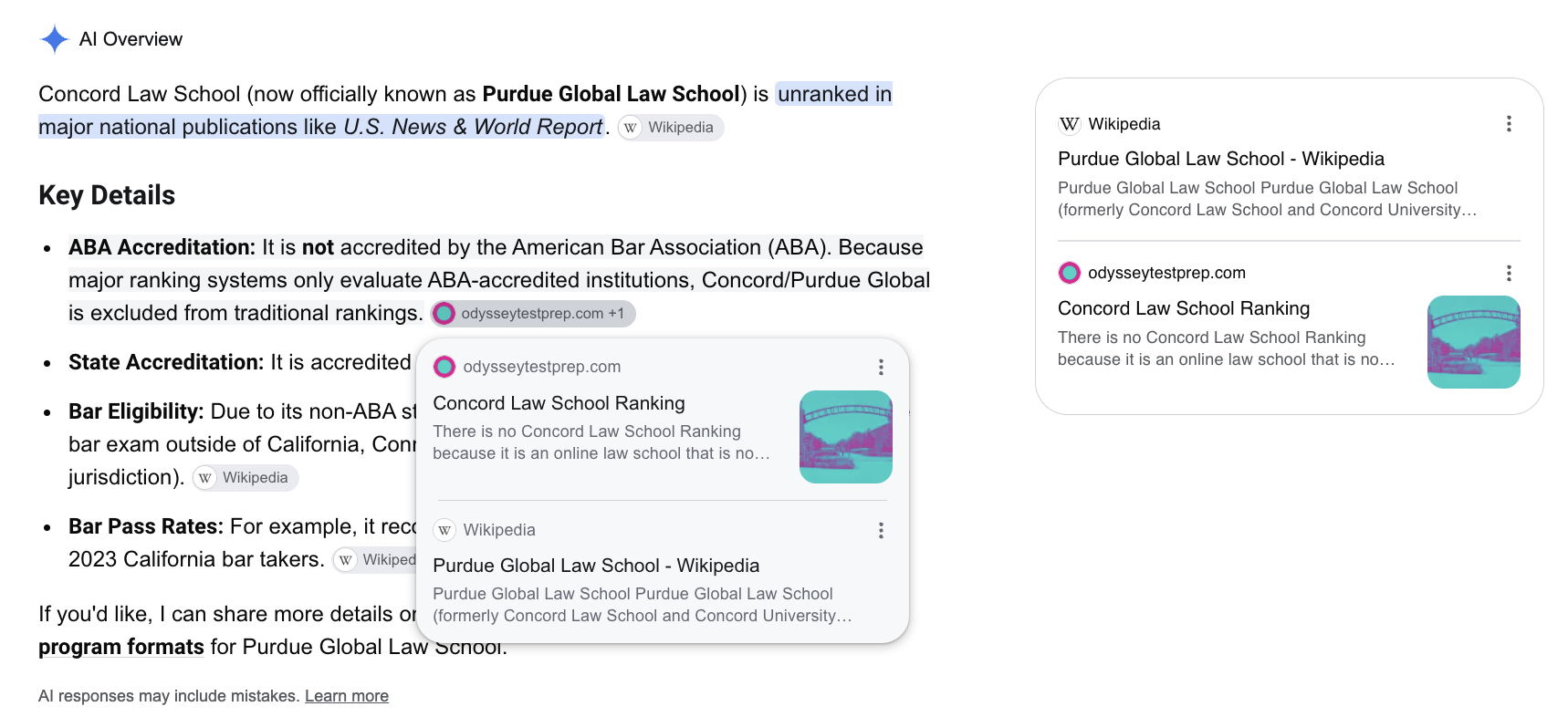
That did not happen by luck. The page answers a specific question clearly, with details most other pages skipped, so Google trusted it enough to quote.
Worth knowing: AI Overviews now appear on a large share of searches and are reshaping how people click, with click-throughs dropping sharply when one shows up. The content that survives is original, experience-based work that an AI cannot replicate.
So two things help you here. First, make your content easy to quote with clear headings and direct answers right underneath. Second, add what only you have: your results, your examples, your point of view.
Doing this on purpose is exactly what AI Search (AEO and GEO) work is about, and it is fast becoming the line between getting quoted and staying invisible.
Common SEO Content Mistakes to Avoid
Most flops come from a handful of avoidable slip-ups. I see these over and over:
- Writing for the algorithm instead of the human reading.
- Stuffing in keywords until it reads like nonsense.
- Ignoring search intent and what is already ranking.
- Publishing raw AI drafts with zero real insight added.
- Chasing rankings while totally forgetting conversions.
Fix these and you are already ahead of most content online. Seriously.
Where Professional SEO Content Writing Comes In
Look, you can absolutely do all of this yourself. And plenty of people lean on AI tools to move faster, which is fine too.
But here is the catch I see all the time. AI tools spit out generic, thin drafts when left alone, and doing everything yourself quietly eats up hours you probably do not have. Both routes still tend to miss the search intent, the trust signals, and the careful editing that actually make content rank.
That gap is exactly what I help with. Everything in this guide, done properly and consistently, backed by how Google really evaluates content.
Here is where I can take the load off:
- SEO Content & Writing: research-backed articles and pages, written and optimized start to finish, so they satisfy both your readers and Google.
- Content Strategy: content maps and keyword clustering, so your pages build authority together instead of competing with each other.
- AI Search (AEO and GEO): structuring your content to get quoted by AI tools, so you show up in AI answers, not just the blue links.
- Platforms & AI Workflows: efficient, platform-specific production, so you can scale your output without losing the quality that ranks.
You have now seen the exact process I use, including real articles of mine that rank and get cited by AI. If you would rather have that done for you, contact me and let’s get your content working as hard as you do.
Frequently Asked Questions
Can a beginner do SEO?
Yes, the basics like keyword research, search intent, and clear structure do not need any technical skills. The learning curve is real, though, so if you want results faster, my SEO content and writing service handles the heavy lifting for you.
Can ChatGPT write SEO content?
It can draft quickly, but raw AI content tends to be generic and often misses the experience and accuracy Google rewards. The real win comes from pairing AI speed with human editing, which is exactly how my process is built.
Can I learn SEO in 3 months?
You can learn the basics and start using them in that time, for sure. Competitive rankings usually take longer, since SEO often needs around 100 days to mature, so working with a pro can seriously shorten that path.
What is the 80/20 rule in SEO?
It means roughly 20% of your effort drives about 80% of your results, so you focus on what actually moves the needle. Knowing which 20% to prioritize is the core of smart content strategy.
What is now replacing SEO?
Nothing, really. SEO is evolving into AI search, where getting cited by tools like AI Overviews matters right alongside ranking, which is exactly where my AI Search (AEO and GEO) service comes in.
Disclaimer: This article is for general informational purposes only and reflects best practices at the time of writing. SEO results vary based on your industry, competition, and effort, and no specific outcome is guaranteed. Search engine and AI guidelines change often, so always check current sources before making decisions.